
Neuroarchitecture: Why Space Changes Us

When I tell people that I’m studying Neuroscience Applied to Architecture & Design, I’m usually met with a blank stare.
“What does that even mean?”
To which I reply: it’s the study of how the spaces around us affect us mentally, physically, and emotionally.
Once people pause to think about it, almost everyone can recall places that made them feel calm, energized, anxious, inspired, lonely, or safe. A cozy café. A harsh fluorescent office. A cathedral. A childhood home. A hospital waiting area.

[photo by Marine Burucoa]
We instinctively know environments affect us.
What most people don’t realize is how deeply.
We still tend to think of our surroundings as a passive backdrop to daily life — something superficial, decorative, or secondary to the “real” experiences happening within it.
But I would argue the opposite is true.
Our environments are constantly shaping us through thousands of subtle subconscious cues throughout the day. There’s no strict determinism here — design can’t guarantee a specific emotional response — but it can dramatically increase the probability of certain feelings, behaviors, and social dynamics.

Architects, artists, and designers have intuitively understood this for thousands of years. Ancient temples, sacred spaces, civic plazas, and homes were all designed to evoke emotional and behavioral responses long before we had scientific language to explain why.
What’s changed now is that science is finally catching up.
That’s one of the reasons I’ve been so excited about this master’s program: it’s helping connect intuition with measurable scientific evidence. Researchers can now observe how environments influence stress hormones, heart rate, blood pressure, cognitive performance, emotional regulation, social behavior, and more.
So why now? What changed in recent decades to create this new bridge between art, psychology, and neuroscience?
One major breakthrough was the discovery of mirror neurons and a growing understanding of something called embodied cognition.
For decades, we relied on computer metaphors to explain how the brain works — models that suggested cognition happens primarily inside the head. Information goes in, the brain processes it, and thoughts and actions come out.
But neuroscience increasingly suggests that it is not as simple as that. Thinking is not isolated within the brain alone. Our minds are shaped through a constant exchange between brain, body, and environment.
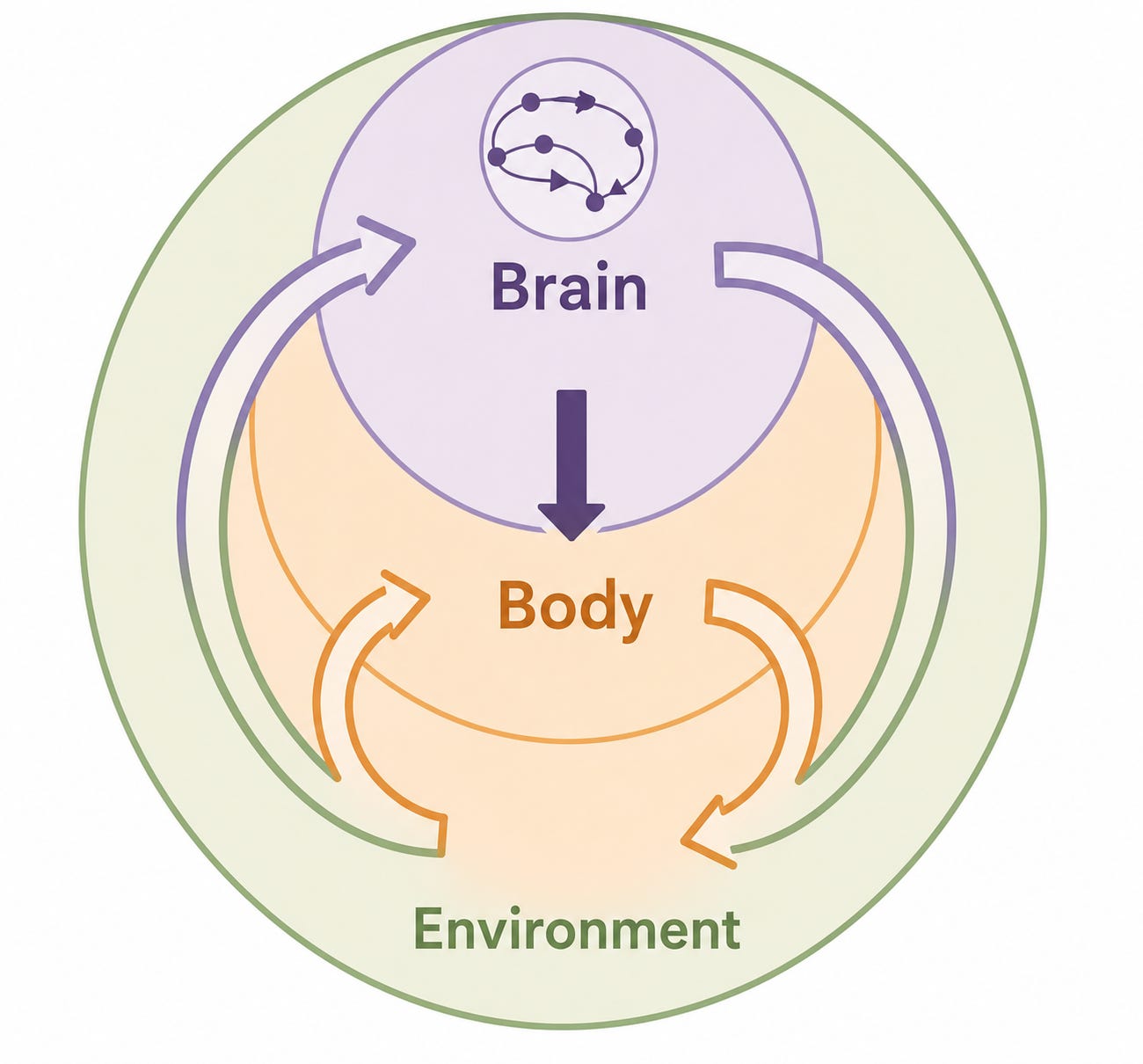
As Annie Murphy Paul writes in The Extended Mind:
“Our culture insists that the brain is the sole locus of thinking, a cordoned-off space where cognition happens. This… argues otherwise: it holds that the mind constructs our thought processes from the resources available outside the brain. These resources include the feelings and movements of our bodies; the physical spaces in which we learn and work; and the other minds with which we interact—our classmates, colleagues, teachers, supervisors, friends.”
Mirror neurons helped reinforce this idea in a powerful way.
Discovered in the 1990s, mirror neurons are brain cells that activate not only when we perform an action ourselves, but also when we observe someone else performing that action. In simple terms, parts of our brains “mirror” the experiences of others.
When we watch someone laugh, cry, dance, tense up, or relax, our nervous systems partially simulate that experience internally. Researchers believe this plays an important role in empathy, learning, emotional contagion, and social connection.
Interestingly, this response can extend beyond people. Even seeing an object with an implied action — like a chair, staircase, or hammock — can activate motor regions of the brain as we subconsciously predict what interacting with that object might feel like.
Embodied cognition expands this idea further. It suggests that cognition is not just something happening in the brain, but something shaped through our ongoing interaction with the world around us.
The posture of our body can influence confidence and memory recall. Movement can affect learning. Light, texture, ceiling height, acoustics, temperature, spatial proportions, and even the emotional states of people around us all shape how we think and feel.
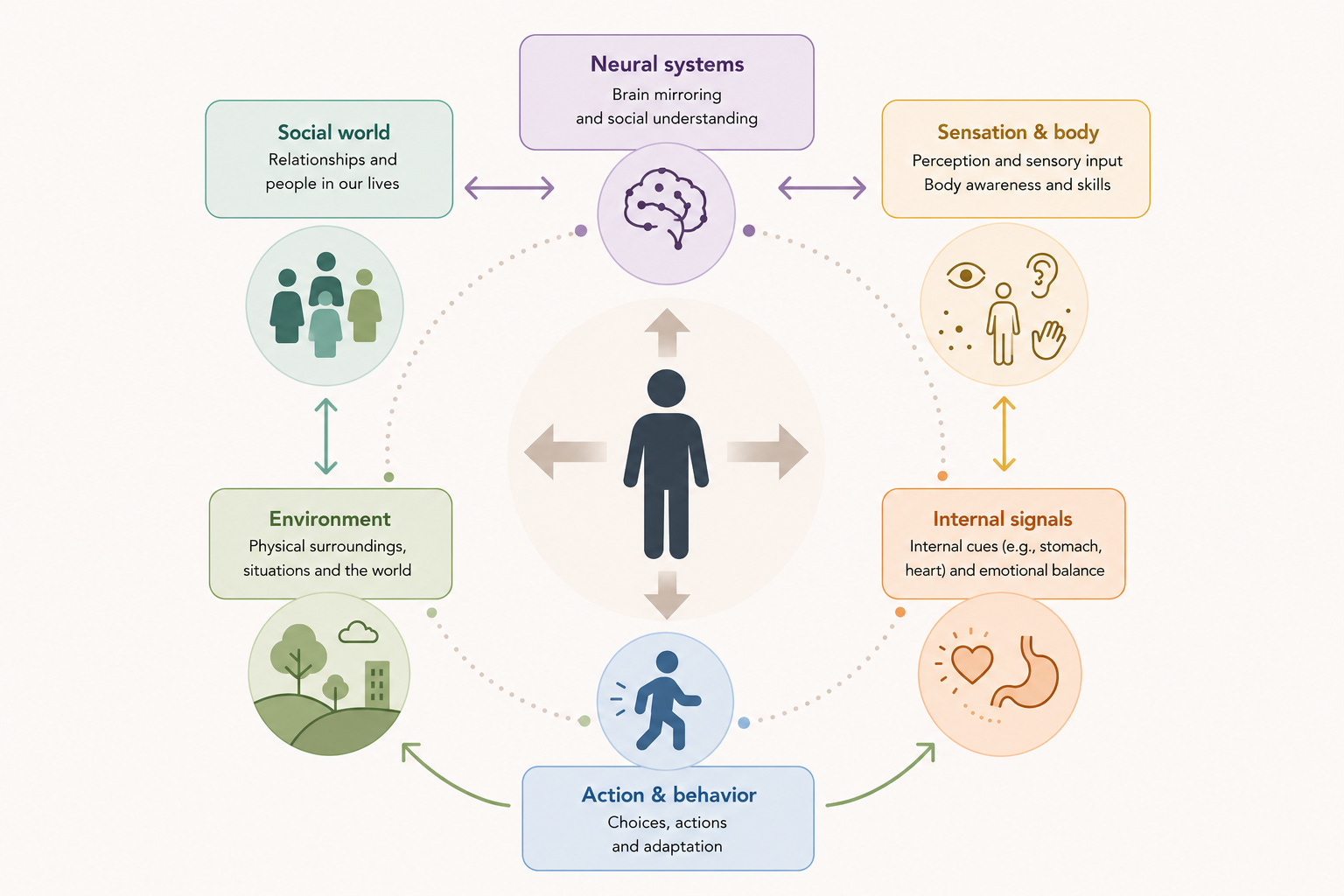
In other words: we do not experience architecture passively.
We experience it with our entire nervous system.
This shift in neuroscience has profound implications for design.
If our motor and sensory systems are activated not only through direct experience but through observation, atmosphere, and social cues — and if our emotions continuously synchronize with those around us — then the built environment becomes far more than a container for life.
It becomes an active participant in shaping cognition, emotion, behavior, and relationships.
That’s the foundation of neuroarchitecture:
the understanding that design choices influence human experience at a biological level.
The spaces we create are not neutral.
They can calm or stress the nervous system.
Encourage connection or isolation.
Support healing or hinder it.
Increase cognitive flexibility or mental fatigue.
Help people feel grounded, welcomed, inspired — or unseen.
And once you start seeing the world through that lens, it becomes impossible to unsee.
This is so validating - thank you for the gift of eloquently explaining what has always been more of a felt sense. I love it when science meets intuition!